日本語三部作
日本語に関する本は、日本語全体を外国語として考える本、日本語を使うための最小限の骨組みにこだわった本、逆に流通しているすべての日本語をみてみようという本、の3冊に集約し、改訂を続けていきます。いずれも、日本語ネイティブだけでなく、すべての日本語を使う人にために作られています。イメージカラーは黒。
The Japanese Language Trilogy
This series of books on the Japanese language is organized into three volumes: one that considers Japanese as a whole from the perspective of a foreign language; one that focuses on the minimal structural framework necessary to use Japanese; and, conversely, one that attempts to examine all forms of Japanese currently in circulation. These volumes will be continuously revised and updated. All are intended not only for native speakers of Japanese, but for everyone who uses the Japanese language. The image color of the series is black.
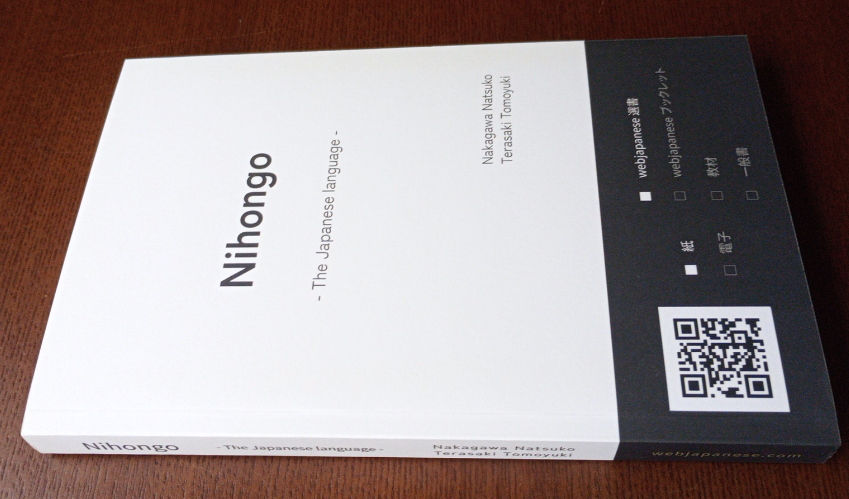
日本語に興味がちょっとある、という人達に向けて、日本語は難しくないよ、おもしろいよ、と許せる範囲で少々誇大広告ぎみに日本語のことを紹介する本です。日本語版と英語版があります。
活用にどうして例外が起きるのか?日本語の音の特徴とは?役割語って?デジタル化で日本語と日本語の勉強方法はどう変わった?「変換」の歴史、キーボード、フリック入力について、変換のやり方、顔文字の発生、日本語の初級って何?日本に留学する、教材の選び方、デジタル環境のこと(フォント、入力方法、変換ソフト)、SNSでの相手の呼び方は?
著者
中川奈津子 国立国語研究所非常勤研究員(博士:言語学)
寺崎 知之 同志社大学 講師(博士:言語学)
監修
橋本 洋輔 国際教養大学 助教(博士:日本語教育)
→ この本は英語版もあります。世界中のアマゾンで電子版、印刷版を販売しています。
This is the english version of Nihongo.
What kind of language is Japanese? Written by typology researchers from universities (PhD holders) and Japanese language teachers, the book is aimed to answer this question.
In the main chapter, we look into the characteristics of the Japanese language through everyday phrases like this, which can often be seen on social media.
What kind of language is Japanese? We wanted to create a book that gives a thorough explanation for people who are not familiar with the language.
The book was co-written by university language researchers (PhD holders) who study the languages of the world, who specialize in topics such as what are the common characteristics among languages and what are their ‘individual characteristics’ (it is a field of Linguistics called Linguistic Typology). It was essential for the book to be written by researchers studying the Japanese language as one of many languages in the world, instead of Japanese language specialists.
We also asked Japanese language teachers with a long history of teaching English speakers, to write about different learning methods. The book is filled with rich information on the ways of studying Japanese by making use of internet resources, a new approach towards studying Japanese in this digital era, and the Japanese input on keyboard and smartphone, together with many useful website links.
If you happen to come in contact with the Japanese culture and become interested in the Japanese language too, we recommend you read this book. You can get to know about the characteristics, history and evolution, writing and sounds, and even the internet slang of Japanese. This book should be interesting, even if you do not intend to study Japanese.
This book is available in English and Japanese. It is an interesting book which gives a fresh perspective for native speakers as well. Those of you with advanced language skills, challenge yourself to read it in Japanese too.
👉 Please note that images may not correctly align with the sentence because some images are shown in Japanese.
👉 Japanese is used in some parts. In most cases, the image will be correctly displayed, but it may have visualizing problems if you are using a hardware which is not compatible with Japanese characters. In such cases, please install a Japanese font to try to see if it can be correctly displayed. Below are some free Japanese fonts which have high readability rates.
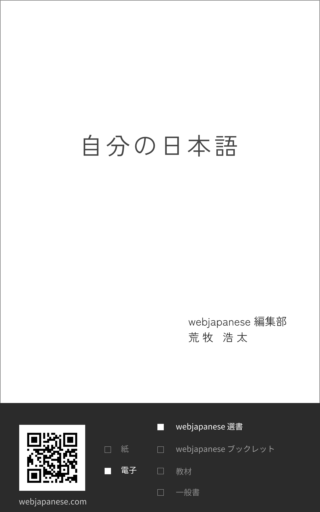
現代日本で流通している、日本語の語と文の表現のほぼすべて、4万弱をリスト化したデジタルデータが付属し、書籍では、スプレッドシートを使ったことが無い人のために、基本から使い方をしっかりと解説します。今後、日本語のことを考えたり、勉強したり、教えたりする時は、スプレッドシートでやりましょう、というご提案でもあります。この1冊で、AI時代に必要なデジタルデータの最も効率的な扱い方と、基本データを一気に手に入れることができます。
著者
webjapanese 編集部 & 荒牧 浩太 編著
Finding My Japanese : Jibun no Nihongo
This is the multilingual version of Jibun no Nihongo.
Available in the following languages.
Finding My Japanese | Descubriendo mi japonés | À la découverte de mon japonais | Mein Japanisch finden | Alla scoperta del mio giapponese | Descobrindo o meu japonês | मेरा जापानी खोजते हुए | Att hitta mitt japanska | Mijn Japans ontdekken | Odkrywając mój japoński | 发现属于我的日语 | 發現屬於我的日語 | Khám phá tiếng Nhật của riêng tôi | मेरो जापानी खोज्दै | ငါ့ဂျပန်စာကို ရှာဖွေခြင်း | Menemukan bahasa Jepang saya | 나만의 일본어를 찾아서 | මගේ ජපන් භාෂාව සෙවීම | การค้นหาภาษาญี่ปุ่นของฉัน | Kendi Japoncamı keşfetmek | Открывая свой японский | Menemukan bahasa Jepun saya | Tuklasin ang sarili kong Hapon |
Jibun no Nihongo is neither a textbook nor a workbook.
We refer to it as “the infrastructure for learning Japanese.”
Use it just like you would water or electricity—for all kinds of applications.
Various studies estimate that the average adult native speaker of Japanese has a vocabulary of around 30,000 words.
This book, Finding My Japanese, comes with an extensive set of digital Japanese language data. It includes 32,000 words, approximately 2,000 phrases, 1,300 sentence patterns, and 1,500 fixed expressions. It also covers around 3,000 kanji characters. By comparison, the highest level of the Japanese Language Proficiency Test requires knowledge of up to 2,000 kanji, and in reality, even native Japanese speakers can confidently write only a little over 1,000 characters.
In other words, this list covers almost the entire range of expressions used by contemporary native speakers of Japanese.
These data are provided in spreadsheet format.
In the 2020s, spreadsheets are freely available and can comfortably handle around 40,000 rows, even on an average computer or smartphone.
This is where AI comes in.
To make effective use of AI, structured language data like this is essential.
The integration of spreadsheets and AI has progressed rapidly.
For example, you can simply ask:
“Create a vocabulary list and sample conversations for a barbershop using commonly used words and sentence patterns,”
and the AI will generate them instantly.
The included My Japanese list is ideally suited for AI use:
each entry is tagged with four levels of usage frequency and five levels of learning difficulty.
In this book, you will learn everything from the basics of using spreadsheets
to advanced customization techniques that combine AI with Japanese language lists.
These lists are updated every year.
Obsolete or rarely used expressions are further reviewed, and on the reader-exclusive support website
you will find profession-specific and situation-based vocabulary lists,
bringing the total to approximately 50,000 entries.
Because the data are digital, you are free to delete, edit, and add entries—
fully customizing the material to suit your own learning goals.
From complete beginners to highly advanced learners,
this single volume provides all the data and practical knowledge needed
for Japanese learning in the years to come.
Use this book to create your own Japanese textbooks, dictionaries, and databases!
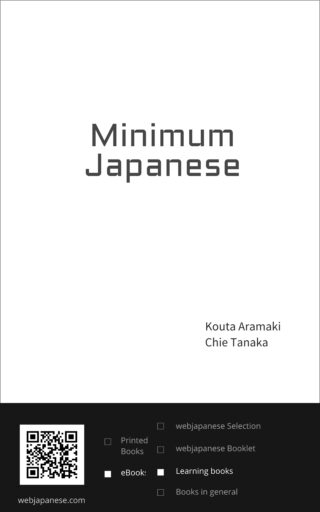
The definitive version of Japanese conversation guide for tourists, created by Japanese teachers.
All you need to do is to understand 10 short sentence structures. By adding vocabularies to them, you can speak natural Japanese like a native speaker.
Over 500 basic vocabulary such as “jidori (selfie)” and “suihanki (rice cooker)” with audio files. Just go over the QR codes in the chapter and hear what they sound like!
10の名詞構文でほぼ大丈夫。「ダメ」は、出来ない拒絶動作しないで使える便利な語、などなど。日本語教師が学習のコスパだけを考えて作った観光用日本語会話の本。行きの飛行機の中でざっと読めば、あとはスマホの辞書で言葉を調べるだけで大丈夫、という新しいコンセプトの簡易日本語会話本です。英語で書かれた本です。(観光や出張で日本に来る人のための日本語会話の本です。本編は英語)